


Residents of the Atayal Aboriginal village of Hagay in Taoyuan County’s Fusing Township (復興) yesterday protested the county government’s 10-year delay in rebuilding their village after the original one was destroyed in a natural disaster.
“We want to go home! We want to go back to a real home!” Hagay residents, accompanied by rights advocates and Democratic Progressive Party Legislator Yu Mei-nu (尤美女), shouted during a news conference at the Legislative Yuan in Taipei yesterday.
“It’s been 10 years and we still live in temporary housing units,” said Tai Li-chuan (戴禮娟), a spokeswoman for the village.
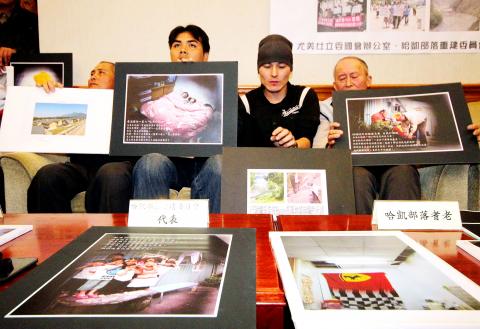
Photo: CNA
“The county government never fulfilled its promise to rebuild the village for us according to our wishes,” Tai added.
The location of the original Hagay Village along the Dahan River (大漢溪) was put in danger in the 1990s because the construction of a dam altered the river’s course.
The dam collapsed in 2001 when Typhoon Nari dumped a massive amount of water in the river’s catchment area, which the dam could not handle, leaving the downstream Atayal Baling Village in ruins.
The government then resettled members of the community in Shangsule — originally only for three years — while promising to build new homes for them there. However, the houses were never built.
In addition to the delay in the reconstruction process, Hagay villagers are also not satisfied with the county government’s plan to build 17 ping (56m2) houses consisting of one room, one bathroom and one living room for each family, saying that was insufficient space for their families, Tai said.
Villagers then put forward their own plans for two or three-story houses last year, but the county government turned down the request, she said.
“The government was quick to demolish the homes of the Wangs in Shilin District (士林), Taipei City, yet it is taking so long to rebuild houses for disaster victims,” Taiwan Association for Human Rights executive member and Soochow University law professor Wu Hao-jen (吳豪人) said, referring to the Taipei City Government’s forcible eviction of a family named Wang (王) on Wednesday last week to make way for a new housing complex.
“The government always says that it acts according to the law, but if our laws are only causing people to become homeless, we don’t know what we need laws for,” Wu said.
However, Taoyuan County’s Indigenous Peoples Bureau Deputy Director Lin Ji-lung (林日龍), who also attended the news conference, rebutted the accusation.
“We have worked hard to fulfill our promise. It took us five years — from 2003 to 2008 — to complete the process of changing the land category of the planned reconstruction site from ‘forestry land’ to ‘building land,’” Lin said.
As for turning down the request to build bigger houses, Lin said that the construction method to be used in the plan initiated by the Hagay residents “is meant for transitional housing units, but we’re looking to build permanent houses.”


UPGRADE: The Kang Ding-class frigate is replacing its Chaparall missiles with Tien Chien II and Hua Yang VLS, which would provide it with long-range, 360° air defense Taiwan plans to produce 1,200 to 1,376 Hai Chien II missiles (海劍二, Sea Sword II) — also known as TC-2N — to serve as the standard air defense system of the navy’s surface combatant fleet, a source said yesterday. Last week, the Hai Chien II, the naval version of the Tien Kung II missile (天劍二, Sky Sword II), completed a live-fire test in waters off the National Chungshan Institute of Science and Technology’s Jiupeng facility (九鵬) in Pingtung County’s Manjhou Township (滿州). The MIM72 Chaparral and other dated air defense missiles that currently arm Taiwanese ships have inadequate range to combat Chinese

REASONS FOR TRAVEL: An assistant professor said that proposed amendments to penalize drivers if they used drugs overseas would not deter people from traveling People who operate a motor vehicle under the influence of marijuana would have their driver’s license revoked, even if they used the substance while overseas, the Ministry of Transportation and Communications said yesterday, citing proposed amendments to the Road Traffic Management and Penalty Act (道路交通管理處罰條例). The amendments would also authorize the government to revoke the licenses of people determined to have used Category 1 or Category 2 narcotics, even if they were not operating a vehicle while under the influence of drugs, as well as ban them from taking the license test for three years, the ministry said. People aged 18 or

Johanne Liou (劉喬安), a Taiwanese woman who shot to unwanted fame during the Sunflower movement protests in 2014, returned to Taiwan last night after being deported from the US. She is to stand trial in Taiwan for charges involving embezzlement, fraud and drug crimes. The Criminal Investigation Bureau (CIB) said it took her into custody at Taiwan Taoyuan International Airport and would first question her before transferring her to the New Taipei District Prosecutors’ Office. She was arrested upon disembarking a flight from San Francisco that landed shortly before 7pm. Liou absconded to the US in 2019 after jumping bail

Shih Hsin University President Chen Ching-he (陳清河) yesterday issued a public apology for comments made in his commencement speech last week, stating that he has asked the school to suspend his duties and halt his wages for two months as a show of contrition. At the commencement ceremony on May 30, Chen said, “If you don’t manage your time well, or your own emotions, or your health, then I am telling every one of you — put a quick end to ‘you,’ because the world has no need for ‘you.’” The comments have sparked significant controversy online, and Chen through an open


 RSS
RSS